
Inflatable Obstacle Courses: Choosing the Right Size and Layout
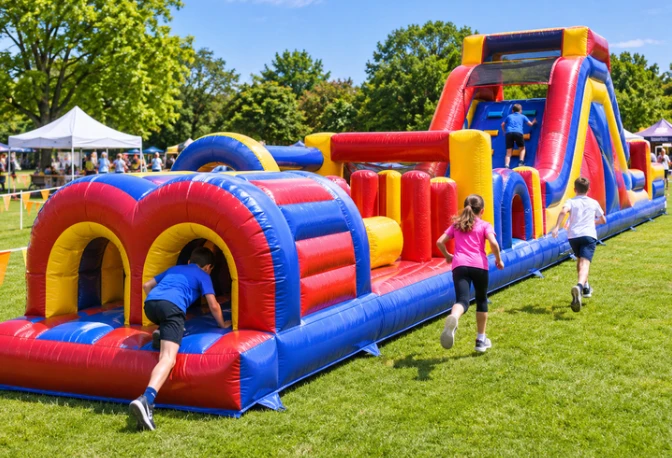
Inflatable obstacle courses come in different lengths and layouts, from compact single-section models to longer courses made up of several connected modules. Choosing between them isn't simply a matter of deciding how much space is available.
A straight 15-metre course may work well for a school fete, while a modular layout could be more suitable for a larger outdoor event. The type of obstacles, the age of the participants and the way people enter and leave the course all affect which design makes sense.
For event organisers and inflatable hire businesses, understanding these differences is a useful starting point when comparing equipment.
Does a Longer Obstacle Course Make a Better Attraction?
Inflatable obstacle courses vary considerably in length. Some are compact attractions designed for smaller events, while others consist of connected sections stretching across a much larger area.
For a smaller event, organisers might start by looking at courses in the 10–15 metre range, then check whether the complete installation footprint suits the venue. The advertised length alone won't tell them how much space the attraction needs.
For events with older participants, a 20–30 metre course offers room for a wider variety of challenges. There might be a tunnel near the entrance, several upright obstacles in the middle and a climbing section leading to a slide at the finish.
Longer courses can also be assembled from several inflatable modules. This approach is particularly useful for event hire businesses that want to offer different configurations, although the sections must be designed to work together.
A short course with challenging obstacles may take longer to complete than a much larger one with a straightforward route. Similarly, a course designed for adults could be unsuitable for younger children, regardless of its dimensions.
The age and abilities of the participants should influence the choice from the beginning. At a family event, it may be more practical to provide a manageable course for the main age group rather than trying to accommodate everyone on one attraction.
The dimensions quoted by a supplier also need careful interpretation. A course measuring 20 metres from end to end will require additional space for its installation, access and safety clearances.
Straight Runs, Modular Sections and Different Layouts
For many outdoor events, a straight-through course is the simplest arrangement.
Participants enter at one end, work through the obstacles and leave at the opposite end. The route is easy to follow, and the start and finish areas can be kept separate.
This works particularly well when a school sports day or community event has a long, uninterrupted section of ground available.
Festival sites, however, often have pathways, temporary buildings or other attractions that restrict where a long inflatable can be placed. In those circumstances, a shorter course or a suitable modular configuration may be more practical.
Modular obstacle courses consist of separate sections that are joined to create a complete route. Depending on the design, an organiser might choose a combination of tunnels, pop-up obstacles, climbing walls and slides.
For example, a modular course might combine an entrance section, two obstacle modules and a climbing-and-slide finish, provided all the sections are designed and approved to operate together.
The main advantage of a modular course is flexibility. A hire business might offer a shorter configuration for one event and a longer version for another, provided the equipment is designed and approved for those arrangements.
Modular layouts can also require additional connections, blowers, electrical supplies and anchoring points, making transport and installation more complicated.
It is equally important to distinguish between modules that are genuinely compatible and separate inflatables that simply happen to be similar in size. Sections should never be joined in an arrangement that the manufacturer has not approved.
For anyone comparing inflatable obstacle courses, checking the available configurations and installation requirements is more useful than relying on photographs of the completed attraction.
Choosing Obstacles That Suit the Participants
Two courses of identical length can feel completely different.
One might feature low tunnels and soft upright barriers, followed by a modest slide. Another could include tall climbing sections and narrow passages that make the route more demanding.
The first may be better suited to a family event with younger participants. The second might appeal to older children or adults taking part in an organised challenge, provided the equipment is rated for their use.
The position of each obstacle matters as well.
If a difficult climbing section sits near the entrance, participants may begin to queue inside the course. Where obstacles are arranged too closely, people may struggle to maintain the spacing required by the operating instructions.
An appropriate sequence of obstacles can make the route easier to manage. A course might begin with relatively simple challenges, move into more demanding sections and end with a slide that leads directly towards a clear exit.
That doesn't mean every course needs to follow the same pattern. The correct arrangement depends on the equipment's design, permitted users and intended operation.
For a corporate team-building day, organisers might prefer a course that allows individual timed challenges or team competitions. At a village fete, a less competitive format may suit the wider range of visitors.
A double-lane design can be useful for certain events, but the number of lanes should not be confused with the number of participants permitted on the equipment. The manufacturer's capacity and operating instructions still apply.
Making the Course Fit the Event Site
A course advertised as 25 metres long will need more than 25 metres of ground space. Blowers, anchor points, safety clearances and a waiting area all need to be accommodated, and the available width matters just as much as the length.
On a school field or festival ground, the position of the course can affect how people move around the site. Ideally, the queue should stay clear of the main pedestrian routes, with enough room at the finish for participants to leave without crossing back through those waiting to enter.
Ground conditions are another consideration. Grass may be suitable for anchoring, but uneven areas, drainage problems and buried services need checking before installation. On hardstanding, the securing method must be appropriate for the equipment and site, rather than relying on improvised weights.
For longer modular courses, allow room for the individual sections to be handled during setup and dismantling. It's worth asking the supplier for a layout drawing showing the full installed footprint, including the required clearances, rather than relying on the product dimensions alone.
At larger events, smaller inflatable games can be placed elsewhere on the site to give visitors another activity while keeping the main obstacle course area less congested.
Safety, Supervision and the British Weather
Before booking an inflatable obstacle course, organisers should check its operating requirements, inspection records and supervision arrangements.
In the UK, organisers should check the inspection and safety documentation appropriate to the equipment. Many commercial play inflatables fall within the scope of BS EN 14960, and suitable devices may carry a current PIPA tag or ADiPs documentation. The requirements should be confirmed for the particular obstacle course, especially when it is intended for adult participants.
Longer courses can present particular supervision challenges. Tunnels, climbing walls and raised obstacles may block the view from one end, making it difficult for a single attendant to monitor the entire route.
Staffing arrangements should therefore reflect the actual design, the manufacturer's instructions and the event risk assessment.
Weather is another factor that can affect the choice of equipment, especially for exposed outdoor venues.
The Health and Safety Executive advises that play inflatables must not be operated in winds above 24 mph (38 km/h), and a lower limit must be followed where specified by the manufacturer. Wind speeds should be measured on site with an anemometer.
Rain, slippery surfaces or changing weather conditions may also require the activity to stop.
For organisers working with a tight event schedule, it is worth discussing these limitations with the operator beforehand rather than assuming that a booked inflatable can remain open throughout the day.
Buying for a Hire Business or Hiring for One Event?
A school arranging an annual summer fete will usually approach the decision differently from an inflatable hire company.
For a one-day event, hiring is often the simplest option. The organiser can select a course suited to the venue without taking responsibility for its long-term storage, maintenance and inspection.
It is still worth confirming whether the quoted hire price includes delivery, installation, supervision, dismantling and insurance.
For a hire business considering a purchase, the calculation is broader.
A long modular course may look attractive in a catalogue, but it also requires suitable vehicles, storage space, blowers, cleaning arrangements and staff capable of handling the equipment.
When comparing suppliers, manufacturers such as EastJump offer different inflatable configurations. Buyers should look beyond product photographs and consider the individual sections, transport requirements and practicalities of repeated installation.
A smaller course that fits a variety of school fields and community venues may receive more regular bookings than a larger attraction restricted to spacious festival grounds.
Modular equipment can offer an advantage when the same sections are suitable for several approved configurations. Even then, the cost and practical demands of the complete system need to be considered.
Before committing to a particular size, a hire business can review the venues it serves most often. If the majority of bookings are for school fetes, the ideal layout may be quite different from one intended primarily for corporate challenge days or large outdoor festivals.
Before hiring or purchasing a course, ask for its full installation dimensions, approved layout options and operating requirements. These details will help you judge whether it is suitable for the venue and the intended participants.

Social Plugin