
Custom Marble Watch Winders and Jewelry Boxes for a UAE Client: A Collaboration Story
Natural stone has become one of the most requested finishes in premium watch winders and jewelry storage, and few markets embrace it as confidently as the Gulf. Guangzhou T.wing-Pak Mfg Co., Ltd. recently worked with a client in the United Arab Emirates to develop a small collection built around that idea: two stone-finish jewelry boxes and two custom watch winders, all designed to sit comfortably in a living room, a dressing room or a private office. This article introduces each piece, explains the engineering choices behind it, and walks through how the project moved from first brief to finished product.
The Brief: Storage That Looks Like Interior Design
The client's starting point was not a technical specification. It was a mood. They wanted pieces that look closer to decorative objects than to gadgets, with soft stone textures, warm neutral tones, gold accents and rich fabric interiors. In a region where natural stone is widely used in homes, hotels and boutiques, a watch winder is often displayed openly rather than hidden in a drawer. That raises the bar for finish, because every surface will be seen and touched.
Behind the styling sat three practical requirements. First, the watch winders had to protect automatic watches properly, with controlled rotation rather than constant spinning. Second, they had to stay quiet enough for a bedroom or dressing room. Third, every product had to cope with a warm, dry and dusty environment with strong natural light, which affects fabrics, adhesives and surface coatings over time. The client also wanted the jewelry boxes and winders to share one visual language, so the whole collection could be gifted or sold as a set.
Meet the Collection
The four pieces below share a rounded, architectural form and a contrast between cool stone and soft textile. Each one solves a slightly different storage problem.
1. Marble Jewelry Box with Emerald Velvet
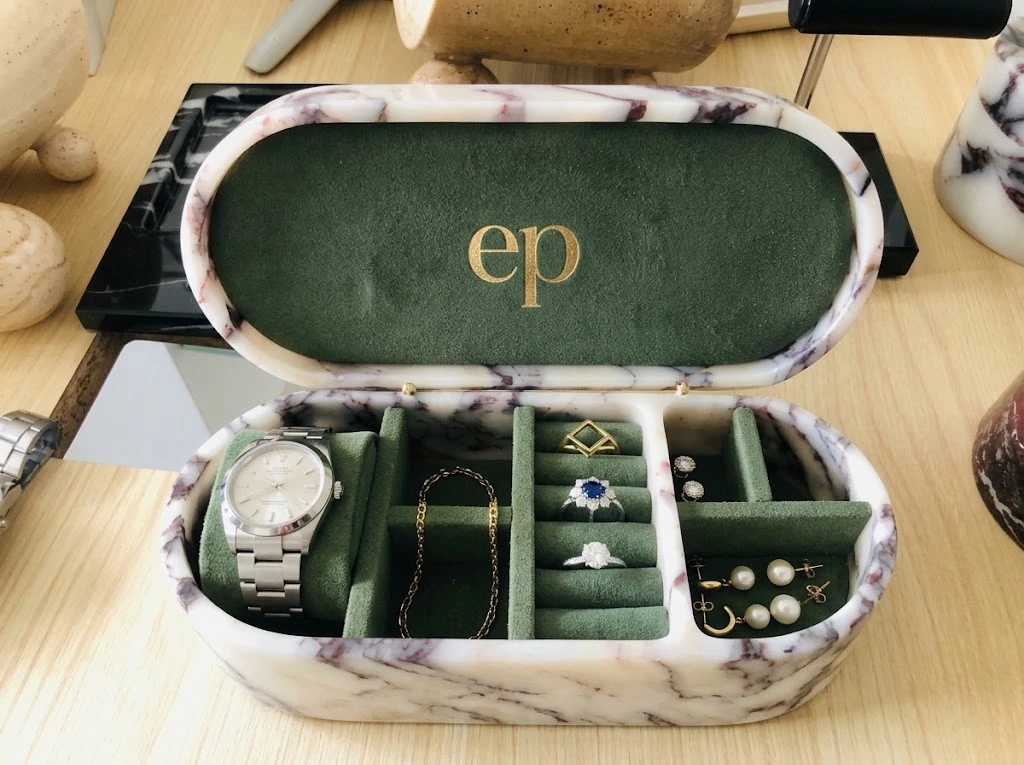
Figure 1. Oval marble jewelry box with an emerald velvet lining and a gold monogram on the lid.
The first piece is an oval jewelry box in white marble with dark grey veining. When the lid opens, the inside is lined in deep emerald velvet, and a gold monogram is set into the lid, giving the client a branded surface without a visible logo plate on the outside. The interior is fitted rather than open: a cushioned watch position, ring rolls, narrow slots for chains and bracelets, and a small open tray for loose items.
Velvet suits this job for practical reasons as well as visual ones. It is soft against polished metal, it holds rings upright so they do not knock together, and its dark green tone makes gold and diamonds stand out. The contrast with the pale, veined stone is what gives the box its character.
2. Travertine-Style Two-Compartment Box with Woven Lining
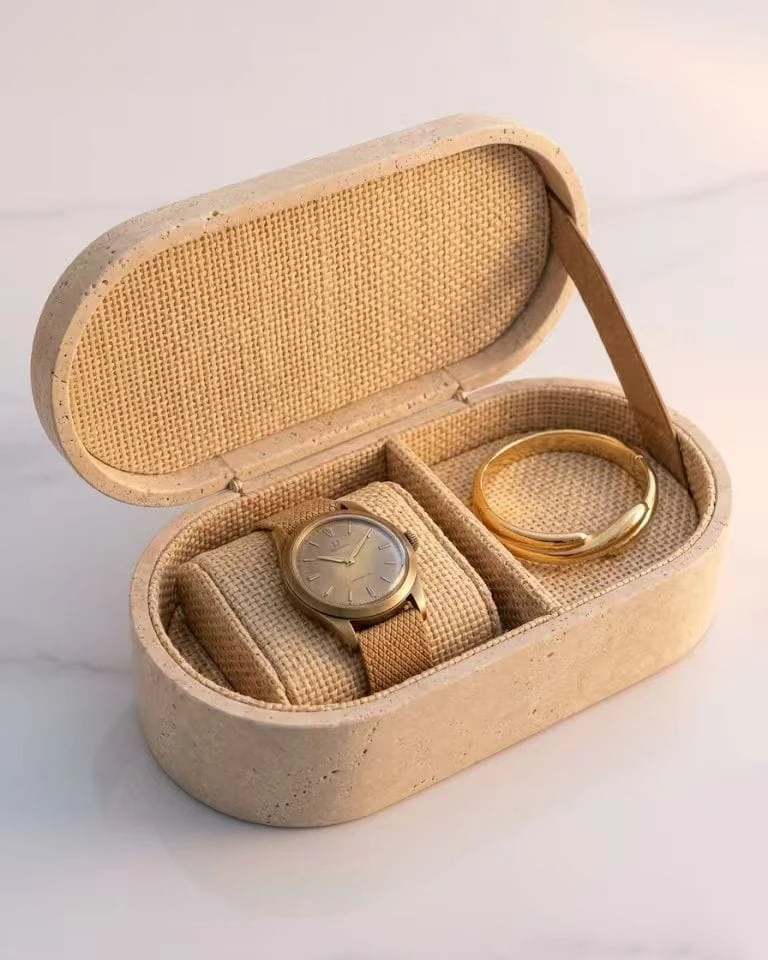
Figure 2. A compact companion box with a watch cushion on one side and an open compartment for a bangle.
The second box takes a warmer direction. Its body is a cream, travertine-style stone with the small natural pores that make the material recognizable, and the lining is a woven natural-fiber fabric in a matching sand tone. One side holds a watch on a soft cushion, while the other side is an open compartment sized for a bangle or a bracelet. A fabric strap supports the lid when the box is open, so it does not fall back while someone is choosing a piece.
This box is designed as a companion to the winders. A client who owns a watch winder usually also wears watches that do not need winding, such as quartz or manual models, and those need safe storage too. A small, attractive box fills that gap on the same dresser.
3. Double Watch Winder in Travertine Finish
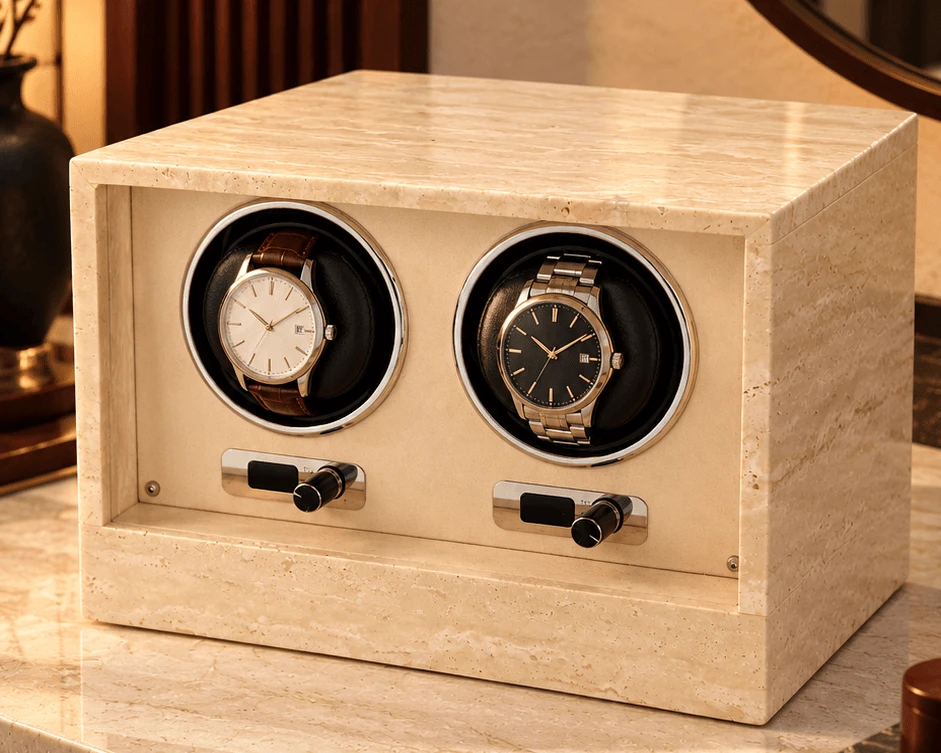
Figure 3. Double watch winder in a travertine finish, with a separate display and control knob for each position.
The double winder is the most functional piece in the collection. A cream travertine cabinet frames two circular windows with polished silver rings, and each window holds a black leather cushion for one watch. Below each position sits a small display and a control knob, so the two watches can be set independently.
Independent control matters more than it may seem. Two watches in the same box rarely share the same movement, and different movements need different winding settings. Many published guides cite roughly 600 to 800 turns per day (TPD) for most automatic watches, with 650 TPD in bidirectional mode a common starting point. A winder that offers separate settings per position lets one owner care for a dress watch and a sports watch at the same time.
4. Single Watch Winder in White Marble with a Glass Door
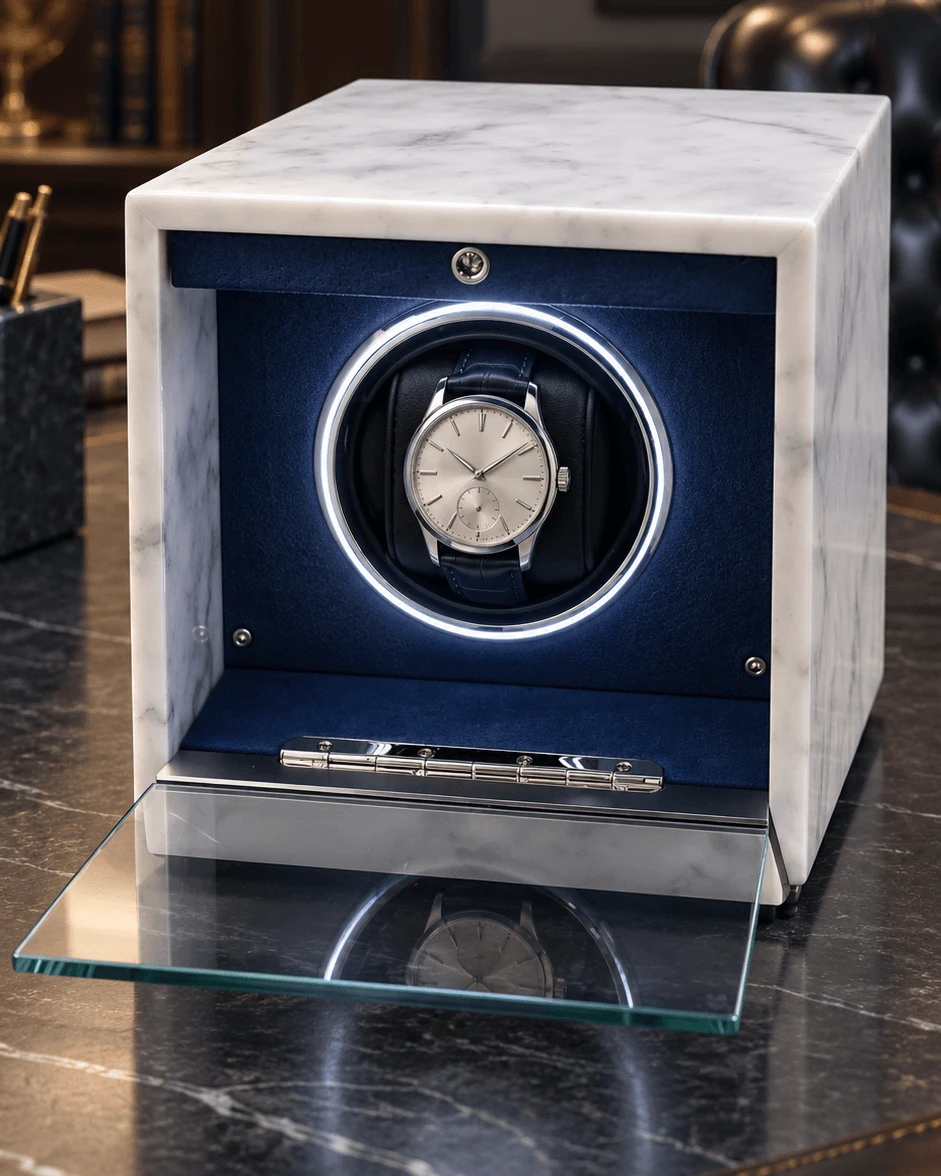
Figure 4. Single watch winder in white marble with a navy interior, a ring light and a hinged glass door.
The fourth piece is a single-position winder for one hero watch. Its cube-shaped body is white marble with soft grey veining, and the interior is lined in navy suede-style fabric. A ring of light around the cushion makes the watch the focus of the cabinet, and a hinged glass door folds down to give access while keeping dust off the watch when closed. Polished metal hinge hardware on the door ties the cabinet to the silver rings used on the double winder.
A single winder like this suits an office desk or a bedside table. It is also the easiest format for gifting, because the buyer only needs to know one watch and one wearer.
Working with Stone: Design and Engineering Choices
Stone looks wonderful, but it behaves differently from wood or plastic. It is heavy, it can chip at edges and corners, and no two pieces have exactly the same pattern. A watch winder adds another layer, because it contains a motor that must be quiet and must not harm the watch. Four areas needed particular attention.
Weight, wall thickness and edges
Solid stone gives the best feel, but weight affects shipping cost and the strength needed in hinges and lids. The structure of each cabinet was therefore planned around the finish, the size of the product and the target price. Rounded edges and generous corner radii, as seen on all four pieces, also reduce the risk of chipping in transport and daily use.
Quiet motors and vibration
A hard stone body can amplify vibration, which turns a small motor sound into a hum. The remedy is to mount the motor and platform on damped supports rather than rigidly against the stone, and to test the finished cabinet with a watch installed, since the added weight changes the sound. Quiet operation is especially important when the product sits in a bedroom or dressing room.
Magnetism and safe winding
Magnetism can reduce a watch's accuracy and, in poorly protected movements, cause more serious problems . A motor contains magnets, so the layout of the motor relative to the watch position matters, and the finished sample should be checked with a magnetometer. Automatic watches typically carry a power reserve of about 36 to 48 hours , so the winder's programmed turning and rest periods need to keep a watch running without turning it unnecessarily.
Natural variation and color matching
Every slab has its own veining. Rather than promising identical pieces, we agreed with the client on an acceptable range: the base color, the density of the veining and the position of any strong marks. This avoids disputes at inspection and lets buyers appreciate that each box is unique.
How the Collaboration Unfolded
A custom project with an overseas client depends on clear stages and clear approvals. The table summarizes how the work was organized, and it can serve as a template for similar OEM and ODM projects.
|
Stage |
What happened |
Client approval |
|---|---|---|
|
1. Brief |
The client shared mood images, target market, preferred stone tones and the number of watch positions. |
Product list and priorities |
|
2. Concept design |
Our team prepared renderings of the four pieces, including lining colors and monogram placement. |
Shape, color and layout |
|
3. Materials |
Stone, fabric and metal samples were compared in daylight and indoor light. |
Material and color range |
|
4. Engineering |
Interior layouts, cushion sizes, motor mounting, controls and lid mechanisms were detailed. |
Technical drawings |
|
5. Sampling |
Working samples were built and tested for noise, rotation settings and finish. |
Pre-production sample |
|
6. Production |
Production followed the approved sample, with inspection at the main steps. |
Inspection report |
|
7. Packing and export |
Protective packaging and export documents were prepared for the UAE shipment. |
Packing plan |
Design before engineering
Because the client began with a mood rather than a spec, renderings did most of the early work. Showing the stone finish, the lining color and the position of the monogram on screen allowed decisions to be made quickly, before any material was cut. Once the look was settled, engineering could focus on making it work.
Samples that settle questions
Photos and renderings cannot show how a lid feels, how loud a motor is or how a stone edge catches the light. Physical samples answered those questions. The client could handle the pieces, test the controls and request small changes to cushion size or lining tone before production began.
Packaging for a fragile product
Stone products need packaging designed around their weight and their edges. Individual protection for each piece, a rigid outer carton and clear handling marks reduce damage in long-distance shipping. Packaging was approved as part of the project, not treated as an afterthought, because a damaged corner on a stone box cannot be repaired on arrival.
Lessons for Brands Planning a Custom Collection
- Start with references. Mood images, color swatches and examples of products you like save more time than a long written description.
- Decide function first. Choose the number of positions, the power type and the settings you need, then let the exterior follow.
- Agree on natural variation. Define what is acceptable for veining and color before production, not at inspection.
- Test with real watches. Noise, rotation and cushion fit only show up with a watch installed.
- Plan for the climate and the route. Heat, light, dust and long shipping routes all influence materials and packaging.
- Build a family. Winders and jewelry boxes that share materials and details look stronger together and sell well as sets.
Summary and Next Steps
This project shows how natural stone, soft fabrics and careful engineering can turn watch storage into part of a room's design. By combining a clear brief, early renderings, tested samples and protective packaging, Guangzhou T.wing-Pak Mfg Co., Ltd. and its UAE client developed four pieces that work as well as they look: a marble jewelry box, a travertine-style companion box, a double watch winder and a single watch winder with a glass door.
Planning a custom watch winder or jewelry box collection? Contact Guangzhou T.wing-Pak Mfg Co., Ltd. with your reference images, target market and the number of watch positions, and our team will help you shape a design and sample plan.

Social Plugin